2012 m. vasario 2 d., ketvirtadienis

Yves Klein


Yves Klein

(1928 - 1962)

Yves Klein was born April 28, 1928, in Nice. From 1942 to 1946, he studied at the Ecole Nationale de la Marine Marchande and the Ecole Nationale des Langues Orientales and began practicing judo. At this time, he became friends with Arman Fernandez and Claude Pascal and started to paint. Klein composed his first Symphonie monoton in 1947. During the years 1948 to 1952, he traveled to Italy, Great Britain, Spain, and Japan. In 1955, Klein settled permanently in Paris, where he was given a solo exhibition at the Club des Solitaires. His monochrome paintings were shown at the Galerie Colette Allendy, Paris, in 1956.

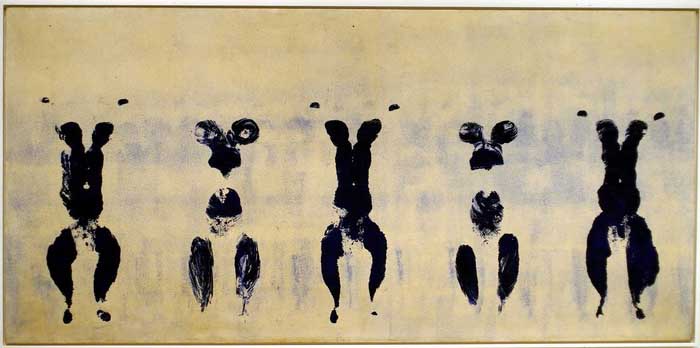
The artist entered his blue period in 1957; this year a double exhibition of his work was held at the Galerie Iris Clert and the Galerie Colette Allendy, both in Paris. In 1958, he began using nude models as “living paintbrushes.” Also in that year, he undertook a project for the decoration of the entrance hall of the new opera house in Gelsenkirchen, Germany. The first manifesto of the group Nouveaux Réalistes was written in 1960 by Pierre Restany and signed by Arman, Klein, Daniel Spoerri, Jean Tinguely, and others. In 1961, Klein was given a retrospective at the Museum Haus Lange, Krefeld, Germany, and his first solo exhibition in the United States at the Leo Castelli Gallery, New York. He and architect Claude Parent collaborated that year on the design for fountains of water and fire, Les Fontaines de Varsovie, for the Palais de Chaillot, Paris. In 1962, Klein executed a plaster cast of Arman and took part in the exhibitionAntagonismes 2: L’Objet at the Musée des Arts Décoratifs, Paris. Shortly before his death he appeared in the film Mondo Cane (1962). Klein died suddenly on June 6, 1962, in Paris.


“I seek, above all, to realize in my own creations…that immeasurable void in which lives the permanent and absolute spirit freed of all dimensions!”

— Yves Klein

Alexander Calder


Alexander Calder, internationally famous by his mid-30s, is renowned for developing a new idiom in modern art-the mobile.

His works in this mode, from miniature to monumental, are called mobiles (suspended moving sculptures), standing mobiles (anchored moving sculptures) and stabiles (stationary constructions). Calder's abstract works are characteristically direct, spare, buoyant, colorful and finely crafted. He made ingenious, frequently witty, use of natural and manmade materials, including wire, sheetmetal, wood and bronze.

Calder was born in 1898 in Philadelphia, the son of Alexander Stirling Calder and grandson of Alexander Milne Calder, both well-known sculptors. After obtaining his mechanical engineering degree from the Stevens Institute of Technology, Calder worked at various jobs before enrolling at the Art Students League in New York City in 1923. During his student years, he did line drawings for the National Police Gazette.
In 1925, Calder published his first book, Animal Sketches, illustrated in brush and ink. He produced oil paintings of city scenes, in a loose and easy style. Early in 1926, he began to carve primitivist figures in tropical woods, which remained an important medium in his work until 1930.

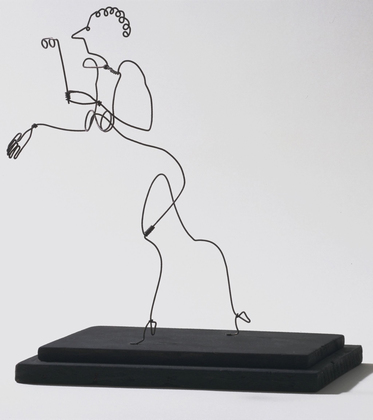
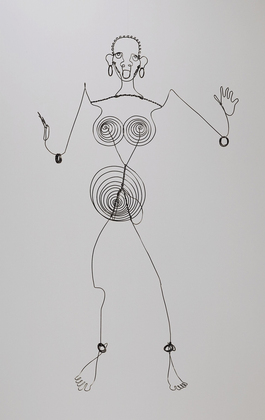
In June 1936, Calder moved to Paris. He took some classes at the Academie de la Grande Chaumiere and made his first wire sculptures. Calder created a miniature circus in his studio; the animals, clowns and tumblers were made of wire and animated by hand. Many leading artists of the period attended, and helped with, the performances.

Calder's first New York City exhibition was in 1928, and other exhibitions in Paris and Berlin gained him international recognition as a significant artist. A visit to Piet Mondrian's studio proved pivotal. Calder began to work in an abstract style, finishing his first nonobjective construction in 1931.

In early 1932, he exhibited his first moving sculpture in an exhibition organized by Marcel Duchamp, who coined the word "mobile." In May 1932, Calder's fame was consolidated by the first United States show of his mobiles. Some were motor-driven, His later wind-driven mobiles enabled the sculptural parts to move independently, as Calder said, "by nature and chance." Calder returned to the United States to live and work in Roxbury, Massachusetts in June 1932.

From the 1940s on, Calder's works, many of them large-scale outdoor sculptures, have been placed in virtually every major city of the Western world. In the 1950s, he created two new series of mobiles: "Towers," which included wall-mounted wire constructions, and "Gongs," mobiles with sound.

Calder was prolific and worked throughout his career in many art forms. He produced drawings, oil paintings, watercolors, etchings, gouache and serigraphy. He also designed jewelry, tapestry, theatre settings and architectural interiors. Calder died in 1976.